
Founded in 1998, HGR*24 buys and sells surplus industrial equipment, connecting vendors looking to recoup capital on used equipment with buyers seeking an affordable alternative to new. Headquartered in Euclid, Ohio, the company serves customers worldwide, with locations across the US and online 24/7.
Executive Summary
HGR*24 runs its entire operation — purchasing, inventory, sales, and accounting — through a single platform called DataFlo. Built more than a decade ago on a niche technology stack out of South Korea, the system had become a liability: Only one outside team, in a distant time zone, could support it, and the business had spent years building workarounds instead of better processes.
When HGR*24 decided it was time to modernize, the challenge was replacing the platform's foundation without ever pausing the workflows that keep purchase orders, shipments, and inventory counts moving.
Results at a Glance
Capmation's DataFlo modernization partnership helped HGR*24 reduce costs and risk while increasing efficiency, resulting in:
- Increased inventory output per worker by over 40%
- Secure backups for an inventory photo archive of 28,000 items
- Decreased maintenance costs by thousands of dollars per incident
- A smooth implementation over a 5-phased rollout
Why Legacy System Modernization Was Needed
DataFlo's limitations showed up across HGR*24's business:
- A niche tech stack virtually no outside engineer could support
- The system ran on Internet Explorer-only code that could fail at any time
- Physical, offsite servers meant a costly contractor visit for any hardware issue
- The inventory photo archive — roughly 28,000 items — had no backup
- The system was too central to the business to take offline
Project Goals
Here's how HGR*24 defined success:
- Move users onto the new system as fast as reasonably possible, without one disruptive cutover
- Rebuild what already existed first, then layer in improvements
- Get off physical infrastructure and reduce dependence on outside contractors
- Migrate users in batches, so any group could fall back if something broke
- Streamline inventory data capture
How It Came Together
Capmation had already spent time understanding DataFlo's legacy architecture, which gave the team a head start most partners wouldn't have had.
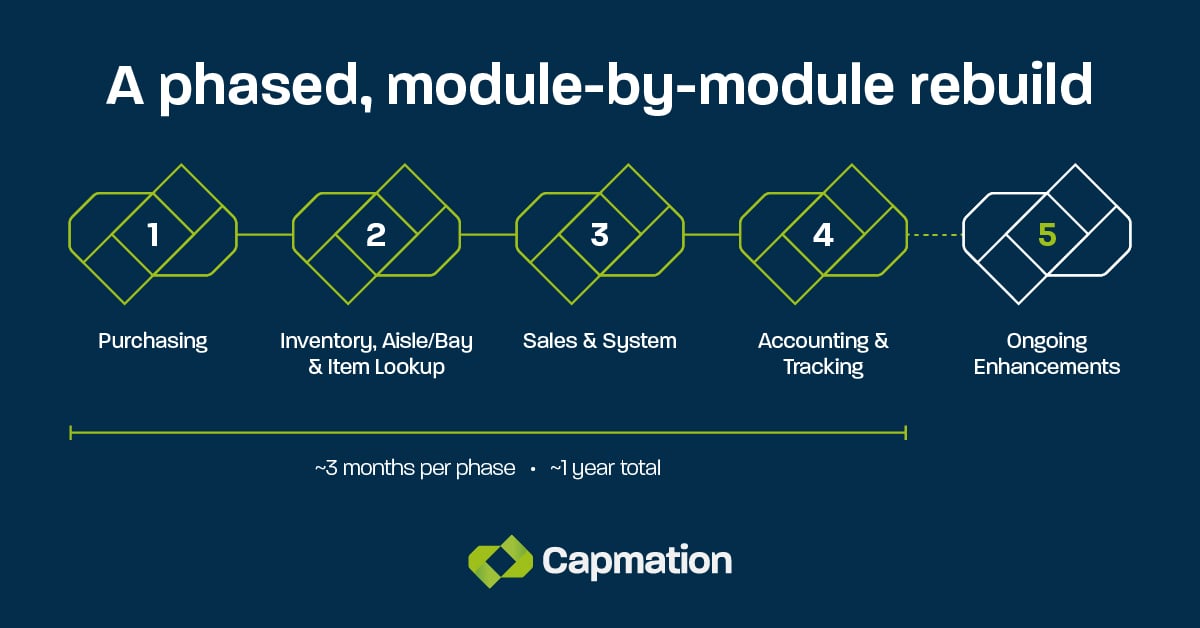
Rather than one high-risk cutover, Capmation and HGR*24 broke the rebuild into 5 phases, each covering one part of the business:
- Purchasing
- Inventory, Aisle/Bay, and Item Lookup
- Sales and System
- Accounting and Tracking
- Ongoing backlog enhancements
New user groups came online roughly every 3 months over about a year. If a module hit a snag, that group could fall back to the legacy system while it was fixed — the rest of the business kept running.
Early Pushback
Early on, there was a plan to also migrate HGR*24's database to a different technology. The Capmation team evaluated it and ultimately recommended against it, as the switch carried real risk of breaking downstream processes, with no reliable way to test every edge case.
HGR*24 was able to keep its existing database and avoided that risk — and the additional costs — entirely.
The Move to AWS
Capmation moved HGR*24's platform from physical servers onto Amazon Web Services (AWS). That ended the need for contractor site visits for routine maintenance and gave HGR*24's lead technical manager, Collin Betori, the ability to make updates himself.
This shift also put the company's inventory photo archive on a backed-up system for the first time, eliminating a significant risk to operations.
Modernized Inventory Capture
The old process meant each worker had to write item details by hand at a machine, then walk back to a shared computer to log it, and then photograph the item separately on a digital camera to add later.
In a warehouse workers described as massive, the constant back-and-forth added up to several miles of walking a day just to get inventory recorded.
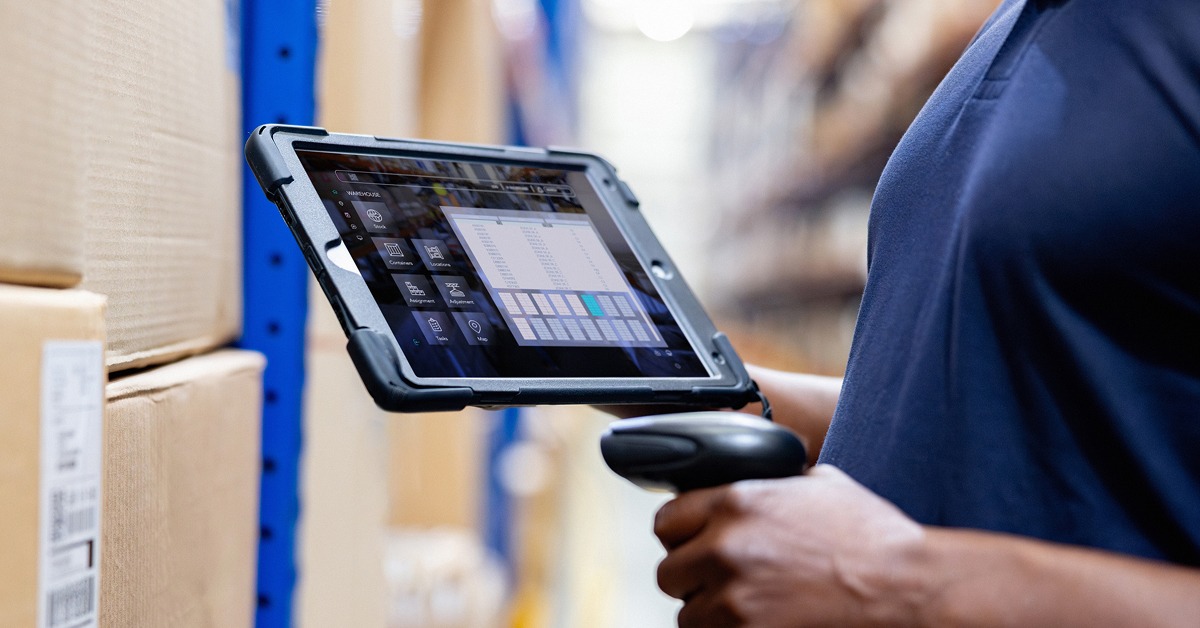
Capmation replaced that entire workflow with an iPad app that captures counts and photos directly against each item, on the spot, closing the gap between the warehouse floor and the system of record.
Collin Betori called it the single most valuable change in the entire project.
Long-Term Partnership
The relationship didn't end at go-live. Phase 5 shifted into ongoing backlog work — prioritized enhancements, integrations, and optimizations — keeping Capmation embedded as the system continues to evolve.
"They’ve proposed thoughtful ideas and created little improvements along the way. I have friends who have been using contractors in India, and they said that communicating effectively was the biggest problem. But Capmation is in the same time zone. If an emergency arose, users would message me along with the Capmation team, and they'd respond right away. They were on it."
— Collin Betori, Lead Technical Manager, HGR*24
Key Takeaways
Lessons from this project that apply to any business-critical modernization:
- A phased rollout meant no group was ever left without a working system
- Partnering with a company that will push back when needed can prevent costly mistakes
- Small wins, like minor UX fixes, help drive adoption
- Time zone alignment with a software partner improves responsiveness
Technologies Used |
Services Provided |
|
|
Curious about how our team might solve a challenge you're facing? Click the link below to request a complimentary Whiteboard Session.