November 25, 2026
In our 20+ year history of creating custom software for businesses, it's difficult to think of a technology that's been as transformative as AI.
Most businesses know they could (and should) be using it to work smarter. Where they get hung up is around the how and why. So in this guide, we'll explore everything you need to know to answer those questions, plus provide an insider's take on what software projects bring value and which don't.
Table of Contents
What AI and Automation Mean for Businesses
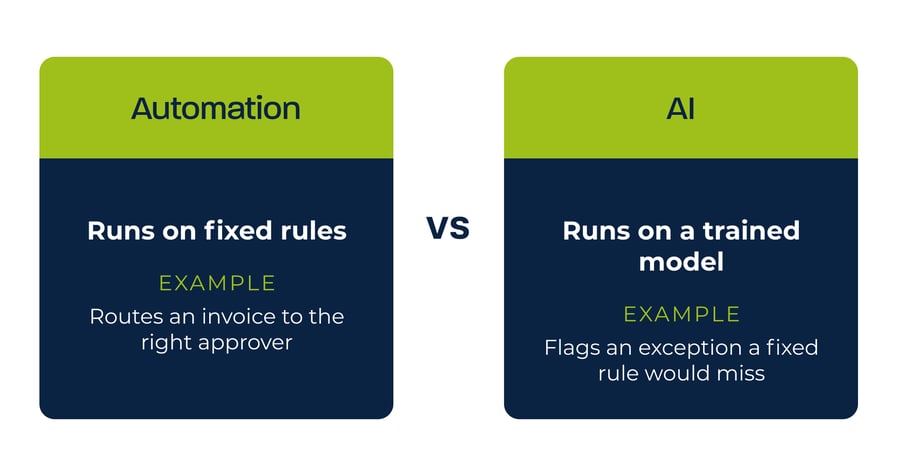
Automation isn't new.
It's in the software that already sends your invoices, triggers your follow-up emails, and runs steps on your assembly line without a person doing it by hand. It follows the same instructions every time, and when something happens that those instructions didn't cover, it stops — and someone has to step in and fix it, or it produces errors in the output
AI works differently.
AI is disrupting businesses for a reason. It learns from data instead of following fixed rules, then uses what it's learned to make a judgment call. Chances are you've already used a version of it — ChatGPT was many people's first hands-on experience.
Where Confusion Leads to Overspending
A lot of what's sold as "AI automation" isn't actually AI at all — it's a rules-based process with an AI label attached to it. The rules handle the repetitive steps and bring in a model only when a decision needs judgment: reading a document, flagging an exception, deciding what happens next.
That's exactly where businesses spend too much.
If you're paying AI prices for something that only needed better rules, you overspent. If you're paying for basic automation on a process that really needs judgment calls, it'll keep breaking no matter how many rules you add.
So in this next section, we'll provide additional clarity, with examples.
When Traditional Business Process Automation Beats AI
Not every operational problem needs AI. A lot of what slows a business down is just work that hasn't been automated yet.
Prime candidates for simple (non-AI) automation include:
- Routing invoices for approval instead of walking them around by hand
- Triggering a follow-up email the moment a form gets submitted
- Moving inventory counts from a paper log into the system automatically
- Kicking off a new-vendor setup workflow without someone starting each step manually
The good news? Plain, rules-based automation is faster to build, cheaper to run, and easier to maintain than a fancier model you don't actually need.
Real-World AI Automation Examples by Industry

Curious about where your industry sits when it comes to AI and automation? Here are some recent numbers to benchmark against:
- 62% of organizations were experimenting with AI, but two thirds of them haven't really scaled it yet
- The biggest adopters by industry include IT and knowledge management businesses, followed by marketing and sales operations
- Slower adopters include manufacturing and supply chain management
The good news? If you've been feeling like you're falling behind, you're probably not. That said, from where we sit, more companies are making bigger moves in 2026, so it's definitely time to get real traction behind any AI and automation initiatives.
Need inspiration? Here's where we find AI and automation add value.
AI Automation Tools for Manufacturing, Logistics, and Distribution
AI in manufacturing shows up most often in a few specific places:
- Production tracking and quality control on the shop floor
- Catching defects on the line before a person would
- Supply chain visibility across multiple locations or vendors
- Inventory accuracy, without someone walking the floor with a clipboard
- Turning shop-floor and product data into more intelligent products
AI Automation in Healthcare
Healthcare runs on documentation and handoffs, which makes it one of the highest-value places to apply AI:
- Catching missing documentation before a compliance audit does
- Automated authorizations and claims processing
- Virtual health assistants
- Routing patient intake information without manual re-entry
- AI-assisted medical imaging triage
AI Automation for Small Businesses
You don't need an enterprise budget to start. Smaller teams tend to get the most value out of AI in the places where headcount is tightest:
- Automating the repetitive parts of a workflow before hiring to cover it
- Testing a new process on one team before rolling it out company-wide
AI in the Hospitality Industry
Guest-facing operations generate a lot of data that most properties still handle manually. Here's where AI can solve age-old challenges:
- Building one guest profile across booking, CRM, and operations systems, so staff have full context without asking guests to repeat themselves
- Routing service requests automatically by type and urgency, instead of relying on someone catching the message
- Giving housekeeping, maintenance, and front desk shared visibility in real time, so a problem gets caught before a guest feels it
- Sending guests relevant updates based on what's actually happening with their stay
The question is the same everywhere: which of your problems need judgment, and which just need better rules.
That's the real dividing line between traditional automation, AI automation, and the hybrid approach most businesses actually need.

AI Automation vs. Traditional Automation vs. Intelligent Automation
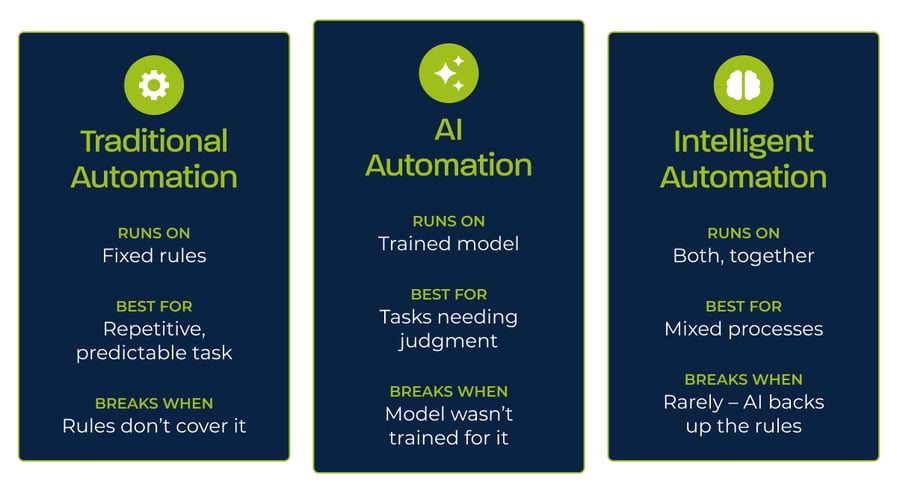
You'll hear three terms thrown around almost interchangeably: automation, AI automation, and intelligent automation.
They're not the same thing, and knowing which one you need keeps you from overpaying for the wrong one.
Traditional automation runs on fixed rules. It's fast and cheap to build — until it hits something outside the rules, and then it stops.
AI automation adds a model that can make a judgment call. It costs more to build and needs more oversight, but it can handle situations rules alone can't.
Where Intelligent Automation Fits in
Intelligent automation combines both under one system: Rules run the repetitive steps, and AI steps in only where judgment is actually needed. Most vendors selling "intelligent automation solutions" are really selling this hybrid.
Analysts also like to use the word "hyperautomation" for a related idea: combining multiple tools — automation, AI, process mining, and orchestration — to automate a whole process at once instead of one task at a time. The label doesn't matter much. What matters is that most vendors pitching it are describing a bigger, pricier version of the same intelligent automation approach above.
We usually recommend starting with intelligent automation on one process, not hyperautomation across the whole operation. Prove it works, then expand.
Incidentally, generative and agentic AI also suffer from the same confusion. Our team explores where that leads to problems in a recent blog.

Traditional Quality Control Automation in Action

Here's a real-world what quality control automation actually looks like.
Novidan is a manufacturer that makes hearing aids. When they came to us, every device needed 15+ minutes of manual testing before it could ship:
- Checking firmware
- Verifying acoustic and wireless performance
- Programming final settings by hand
Each manual step was also a chance for data entry to go wrong.
So we helped them build a system that runs those same three steps automatically for every device — with results tied directly to each unit's serial number instead of typed in by hand.
Result: Testing time dropped from 15+ minutes to under 5 minutes per device, and hundreds of units now move through in days instead of weeks.
This is traditional automation in its clearest form: fixed steps, repeated exactly the same way every time, with no judgment call anywhere in the process. That's exactly why it holds up at volume.

Calculating AI ROI
"Efficiency gains." "Transformation." Those words are common in AI pitches, but they don't tend to survive a budget conversation.
Here are the kinds of gains you can tie real numbers to:
- Faster response times — requests get routed to the right person automatically, instead of waiting for someone to notice them
- Fewer errors and less rework — judgment calls get handled by a model instead of a rushed employee guessing under pressure
- More staff capacity — people spend time on work that needs a human, not manual data entry or chasing down information
- More consistent outcomes — quality stops depending on which employee happened to handle it that day
Here's the part that trips up most business cases: these initiatives rarely live in one budget line or one department. They touch revenue and cost differently, on different timelines, and the value shows up gradually instead of all at once.
Once you can see where the recurring costs actually sit — rework, response delays, staff hours lost to manual coordination — the case for AI or automation stops being a guess and becomes a number you can defend to your board.

How To Keep AI Implementation Moving
As of 2026 data, only 32% of organizations are currently running agentic AI.
The tech can provide incredible value, but here's where projects go sideways:
- Trying to fix everything at once, instead of proving value on one process first
- Working tools sitting unused because no one owns adoption
- Treating the model as foolproof, so nobody catches it when it's wrong
- Not bringing in frontline workers early
A Simplified AI Readiness Assessment
Here are the questions you should have solid answers to before you start scaling AI:
- Do you have a specific process in mind, with a measurable problem, or just a sense that AI should be part of this somewhere?
- Is the data for that process clean and accessible?
- Have you sorted which parts need fixed rules and which need judgment?
- Is there budget and leadership buy-in for at least a pilot?
Insider Tips on Moving Forward
- Bring in frontline workers before you build, so your tool will fit exactly how they work, and adoption will go smoothly and quickly
- Be specific about what changes for the people using it: which tasks go away, and what they get to spend that time on instead
- Give the tool an owner after launch
- Decide what "good enough" looks like before you start, so you're not chasing perfect results
- Roll your new tool out in stages, so you can see proven ROI before you expand
- Bring in outside help for the first project to anticipate issues and catch problems faster
AI is disrupting businesses at an incredible pace, and a software partner that's already mastered using it in the development process can help you get faster delivery rate.
Our Approach to Custom AI Solutions
Custom AI solutions are built on your own data, tuned to your specific workflow, and engineered by people who understand what's happening under the hood, not just what prompt to type. That last part matters more than it sounds — 45% of AI-generated code has a known security vulnerability when no one experienced reviews it before it ships.
We use AI throughout our own process to move faster for clients, but a skilled engineer is always accountable for what goes into production. AI speeds up the work. It doesn't replace the judgment that makes the work good.
That's the difference between a tool that works in a demo and one that holds up in production. An engineering-led approach catches the vulnerabilities, edge cases, and integration problems that don't show up until real data and real users hit the system — before they become your problem instead of ours.

FAQs About Business Process Automation and AI
Straightforward answers to the questions that come up most when evaluating AI and automation for your business.
What is AI automation?
AI automation uses a trained model to make judgment calls, instead of following a fixed set of rules. It's suited to tasks like reading a document, flagging an exception, or deciding what happens next — the parts of a process that plain automation can't handle on its own.
What is business process automation?
Business process automation uses software to run a repeatable task without a person doing each step by hand — think invoice routing, follow-up emails, or inventory updates. It works best on predictable, rules-based work, not tasks that require judgment.
What's the difference between AI and automation?
Automation follows fixed rules and does the same thing every time. AI learns from data and makes a judgment call instead of following a script. Most business processes need a mix of both, which is where intelligent automation comes in.
What is hyperautomation?
Hyperautomation means combining multiple tools — automation, AI, process mining, and orchestration — to automate an entire process at once instead of one task at a time. It's a larger-scale version of intelligent automation, and most businesses see better results starting with one process before expanding to this scale.
What should an AI readiness assessment include?
At minimum: a specific process with a measurable problem, clean and accessible data for that process, a clear sense of which steps need automation versus AI, and budget or leadership buy-in for at least a pilot.
At Capmation, A Business Optimization Workshop covers all four with your team.
Why do most corporate AI implementation projects fail?
Most failures come from execution, not the technology. Common causes include trying to fix everything at once, skipping frontline workers when designing the tool, and treating a model as flawless with no one checking its results.
What does intelligent automation consulting include?
It means evaluating which of your processes need fixed rules, which need AI-driven judgment, and which need both — then building and maintaining that system as your business changes, not just handing off a one-time build.
What are AI automation services?
They cover the full lifecycle of an automation or AI system: build, testing, deployment, and ongoing monitoring and retraining as data and business needs shift. It's an ongoing relationship, not a single project.
Request Complimentary Operational Efficiency Consulting
If you've ever wondered how a software engineering firm would approach business optimization and operational efficiency, you're welcome to pick our brains.
In a Whiteboard Session, you can bring us a few problems you're struggling with, and our team will brainstorm with you on the best potential solutions, plus provide cost and timeline estimates you can take back to your board.
To be clear, these aren't sales pitches for our team. They're just a way for executives to start transforming a problem or an idea into an action plan.
Topics: Automation | Artificial Intelligence | AI Development