September 23, 2025
Every software development team’s goal is to create a great finished product, on time, and on budget. It doesn’t always work out that way. Traditional software development has earned a certain reputation for missed deadlines, blown budgets, and products that don't meet the needs of end-users.
Fortunately, software developers are excellent problem solvers and have pioneered a new way of building software that can minimize these issues. It's called Agile, and in this blog, I’ll explain everything a C-suite executive needs to know about what it means, when it’s needed, and what to look for in an Agile development team.
Common SDLC Methodologies Explained

Both Agile and traditional methodologies follow the same fundamental phases. The key difference lies in how these phases are sequenced and executed.
Waterfall SDLC
In traditional software development (known as Waterfall), each of the following phases must be completed in order before moving to the next:
- Analyze requirements
- Design
- Build
- Test
- Deploy
- Maintain
Agile SDLC
The Agile methodology takes these same phases, but executes them iteratively in overlapping cycles called sprints.
For example, while developers build current features, business analysts gather requirements for upcoming sprints, designers create mockups for future functionality, and stakeholders provide feedback on recently completed work.
Each phase of the Agile process looks more like this:
- Discovery
- Sprint cycles
- Ongoing release
Each sprint lasts 2-4 weeks, providing more opportunities for flexibility and improvement throughout the process.
Problems Associated With the Traditional Software Development Lifecycle
Picture this: You spend months defining every detail of your software project upfront. Your dev team disappears for seven or eight months to build it. When they finally emerge, the software doesn't match what your business actually needs — because your needs changed, the market shifted, or the original requirements were simply misunderstood.
Sound familiar?
With the Waterfall methodology, software development is a bit like following a new recipe. You gather up everything you need, and then work through the recipe in an orderly, linear way. It typically takes longer to cook, and you could get all the way to the end, only to find out you don’t like the meal.
Therefore, it should come as no surprise that Waterfall development is associated with these common pain points:
- Requirements become frozen early in the process
- Any misalignment between expectations and delivery only becomes apparent during final testing, when changes are most expensive to implement
- Stakeholders can start to lose confidence in the solution because they haven't seen tangible progress for months
- When problems arise, it becomes easy to point fingers at "unclear requirements," "scope creep," or "unrealistic expectations" — when the real culprit is a process that makes collaboration and course-correction nearly impossible
If you haven’t already experienced some of these issues firsthand, here are a few recent stats that can help quantify the problem:
- Agile’s success rate is 64%, while the Waterfall methodology delivers at 49%
- 74% of developers said that Agile methodologies reduce uncertainty
- Waterfall methodology tends to take 20% longer
A Real-World Timeline Comparison
Let's examine how the same project would unfold under both methodologies:
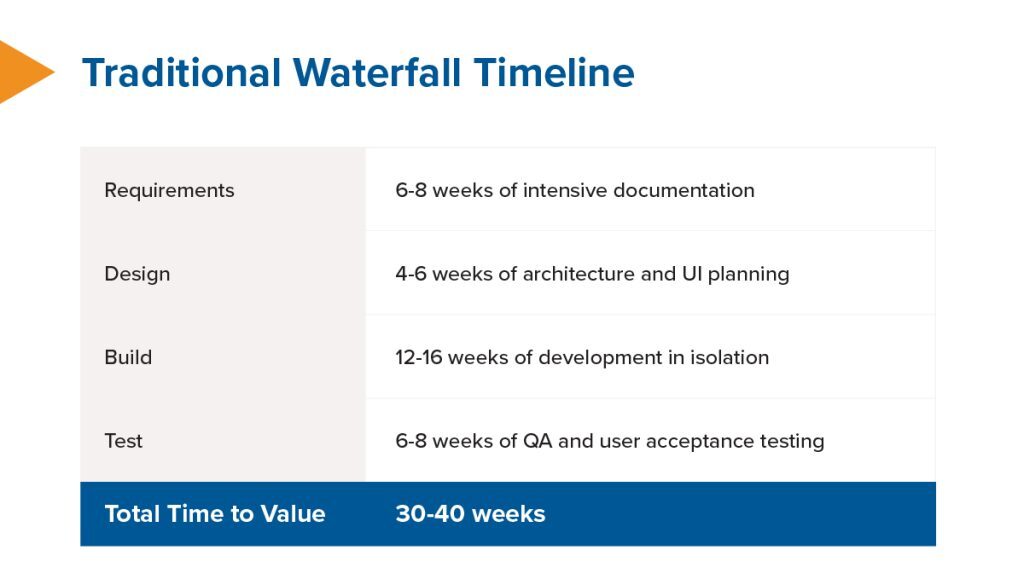
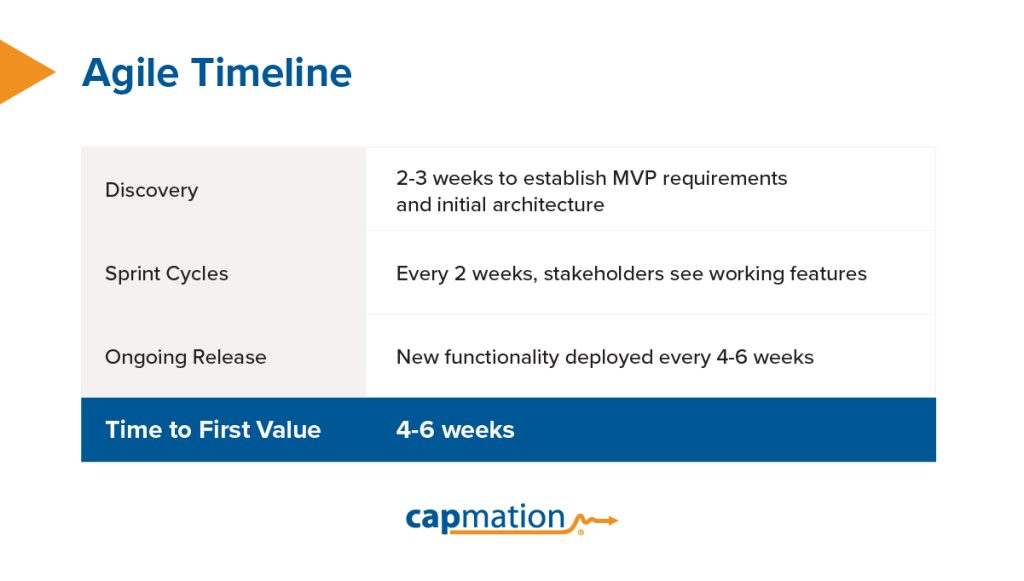
Rather than waiting nearly a year to see results, Agile delivers working software within the first month and continues providing incremental value throughout the project.
Projects Where the Traditional SDLC Process Still Makes Sense
Neither software development methodology is all good or all bad! The Waterfall approach is sometimes a good fit for projects that have these characteristics:
- There's a clear, unchanging end goal
- You have a strict budget and/or timeline with little flexibility
- The project requires minimal collaboration and feedback
- Regulatory requirements demand extensive documentation
When To Consider Agile SDLC
Let’s go back to that cooking analogy I used before. If the Waterfall approach is like following a recipe, using Agile SDLC phases is more like how a chef would approach creating a new dish — tasting as they go, making adjustments as needed, and adapting their dish based on what’s working well.
Therefore, Agile software development is usually a better approach for projects that have these characteristics:
- There are uncertain or evolving requirements
- The end-user’s experience is key to your project’s success
- Your project will require significant technical discovery
- You’re in an especially competitive or fast-moving market
- You anticipate complex integration challenges
What To Expect From Agile Development

Traditional SDLC management focuses on plan adherence. Success is measured by how well teams deliver against predetermined specifications, timelines, and budgets. Changes require formal approval processes, and deviations from the original plan are viewed as failures.
If you’re considering Agile development for the first time, it’s often a significant adjustment for executives. With Agile development, not everything can be defined perfectly at the start, and success is measured by how quickly teams can put valuable features in users' hands and how effectively they respond to new information.
This shift requires executives to become comfortable with some ambiguity upfront in exchange for continuous validation throughout the project and faster ROI.
6 Things Executives Should Look for When Hiring an Agile SDLC Developer
In order to be successful, Agile software requires close collaboration and efficient, transparent communication. If Agile software development is the best fit for your project, and you don’t have those capabilities in-house, here’s what I’d recommend looking for in a partner.
1. Strategic Focus Over Sales Pitches
The best Agile partners approach your project from a strategic and technical perspective, not a sales one. They're focused on understanding your critical business needs and developing solutions that align with your long-term goals.
2. Attention to Detail
This is non-negotiable — effective Agile partners will maintain rigorous quality standards despite rapid development cycles.
3. Education and Support
You shouldn’t have to become an expert in Agile software development to have a successful partnership.
A good partner will help you understand what to expect from the Agile process. They should demonstrate how you'll see working software within weeks — not months — and help you prepare for the level of engagement Agile requires. They should also demonstrate some flexibility to communicate in the way that works best for you.
Pro tip: These projects can be long and expensive, and your partner should also be committed to providing you with the best possible experience.
4. Seasoned, Collaborative Teams
Look for teams where business analysts, project managers, and developers work collaboratively rather than in silos. Agile development requires seamless coordination between roles, with team members who can remove blockers quickly and maintain quality standards throughout rapid development cycles.
At Capmation, we’ve been engineering custom software since 2003 — a rarity in our industry. In that time, we’ve seen what works, what doesn’t, and how to make sure we go above and beyond for our clients every time.
5. Strong Communication
Clear, consistent communication keeps all stakeholders informed about progress, risks, and decisions needed. Every sprint should include demonstrations of working software and structured opportunities for feedback. This transparency builds confidence and catches issues early.
A word of caution: real-time collaboration can be tricky when you’re working with an offshore development partner. Although you may save some money up-front, you may have language barriers, different workplace norms, and very few (if any) overlapping working hours.
6. Proper Planning and Preparation
Successful Agile projects need a focused discovery phase that establishes core requirements, creates initial architecture, and aligns all stakeholders before development begins.
Or at least, that’s what should happen each and every time.
Over our 20+ years in the business, we’ve heard quite a bit about partnerships gone wrong. And many clients who haven’t worked with us before are often surprised at how we approach custom software. We get to know your teams, your other tools, your processes, and much more to make sure that we’re designing a tool that does more than just solve an immediate problem. Our ultimate goal for every project is to bring you something uniquely valuable that makes it easier for your business to succeed now and in the future.
Key Takeaways for Decision-Makers
Technology is evolving at an unprecedented rate. The companies that will succeed in 2025 and beyond aren't the ones with perfect plans. They're the ones that can adapt quickly, learn from feedback, and deliver value consistently.
Traditional software development asks you to bet everything on requirements that become set in stone. Agile development thrives on adaptation and continuous improvement, which tends to make it a better fit for modern businesses. However, in order to be effective, Agile requires more collaboration.
If you’d like to do a deeper dive into our discovery process or the kinds of results we’re able to achieve for our clients, click the link below to browse our portfolio.
Topics: Software Development | The Capmation Way