April 20, 2026

Post written by: David Ward
All AI is not the same. The tool your team uses to draft emails or summarize meetings is fundamentally different from an AI system built around your proprietary data to drive operational decisions. Understanding that difference is the starting point for any serious conversation about a custom AI project for your business.
But that's not the only misconception that comes up around this topic. So in this blog, I'll explore what you need to know before getting started.
The Difference Between Off-the-Shelf AI and Custom AI
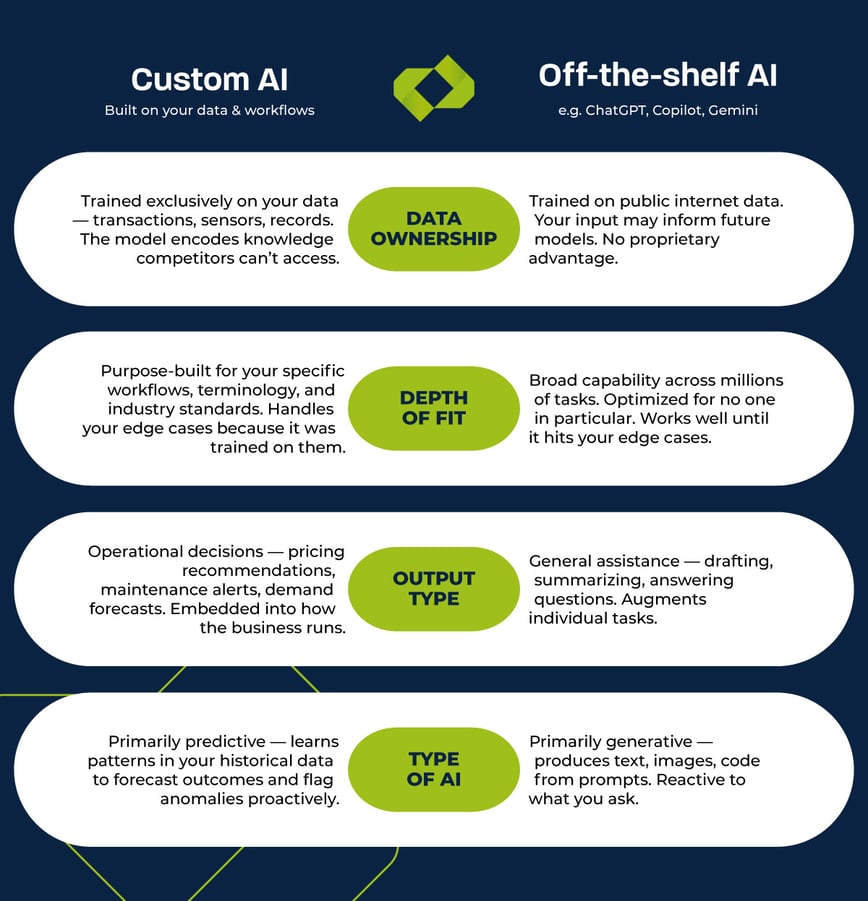
The distinction between off-the-shelf and custom AI runs deeper than most business leaders realize. It's not just a question of features — it's a difference in four fundamental dimensions.
Data Ownership
Generic AI tools are trained on public internet data. Depending on the model and plan you're using, your inputs may help improve someone else's model, and you're not building any proprietary advantage.
Custom AI is trained on your data, which means the patterns it learns about your customers, operations, and outcomes belong exclusively to you.
Depth of Fit
Off-the-shelf tools are optimized for breadth — they perform reasonably well across millions of use cases. But a tool built for everyone isn't going to be fine-tuned for anyone.
Custom AI is purpose-built around your specific workflows, your industry's terminology, and your operational edge cases. It doesn't just help you handle problems well; it was designed specifically for them.
Output Type
This is where the practical difference becomes most tangible. Generic AI augments individual tasks — it helps someone draft an email faster or summarize a document.
Custom AI is embedded into operations — it generates pricing recommendations, fires maintenance alerts, or surfaces demand forecasts. It doesn't assist human work so much as it becomes part of how your business runs.
Type of AI
When most people picture AI today, they're picturing generative AI that produces text, images, or code from prompts.
Custom AI tools are focused on predictive machine learning: models that surface patterns in your historical data to forecast what's likely to happen next. That's a fundamentally different kind of intelligence — one that's proactive rather than reactive.
Requirements for Custom AI Model Development
If there's one thing that trips up executive teams exploring custom AI, it's the assumption that it's quick and easy.
It isn't.
Building a custom AI solution requires:
- Proper infrastructure
- Intentional data management
- A clear understanding of what your data contains and what it can support
Skipping those foundations doesn't just slow the project down. It guarantees weak results.
Here's a dynamic we see often: over the past several years, companies have been collecting massive amounts of data. Transactions, sensor readings, customer interactions, operational logs. But collecting that data and understanding it are two different things.
A lot of organizations are sitting on years of accumulated information with no clear strategy for activating it.
When Does Custom AI Make Sense?
If you're looking to augment individual tasks — drafting, summarizing, researching — generic tools do that well. But if you're trying to embed decision-making directly into your operations — pricing, forecasting, maintenance, risk — that's a different problem entirely. Generative AI wasn't designed for it, and no amount of prompt engineering changes that.
These are the signals you're in that territory:
- You need to make data-driven decisions at scale
- Your business is growing quickly, and your tools and processes aren't keeping up
- You're looking for a competitive edge
-
You've identified specific use cases where your data could power better outcomes
Real-World Use Cases for Custom AI

Here are a few examples of what custom AI projects tend to look like:
Dynamic Pricing
Imagine a business with years of pricing history, inventory data, and market signals. A custom AI model can ingest all of that, establish pricing rules, make predictions, and generate recommendations about what pricing should be in real time.
A human can still make the final call, but the decision is now informed by a custom AI model that understands the business deeply.
Predictive Maintenance
For companies operating large equipment with IoT sensor connectivity, a custom model can read those sensors continuously, learn the patterns that precede breakdowns, and flag when maintenance is needed before a failure occurs.
Financial Risk & Fraud Detection
A financial institution sitting on years of transaction data has something most fraud detection platforms don't: a precise picture of what normal looks like for their specific customers and products.
A custom AI model trained on that history can identify anomalies, flag suspicious patterns, and assess risk in real time — with far fewer false positives than a generic model calibrated for someone else's data. The proprietary signal is the advantage.
What Has To Be in Place Before You Build
The most important prerequisite for custom AI isn't the algorithm or the platform — it's the data infrastructure underneath it.
Specifically, that means:
- A structured, automated data ingestion pipeline
- Clear rules and processes for ongoing data cleaning
- Scheduled, reliable data flows that keep the model current
- A security and compliance posture appropriate for the sensitivity of the data involved
A sophisticated model sitting on messy, inconsistent data will produce weak, unreliable outputs. Getting the data foundation right is what makes everything else possible.
Pro tip: Data security and compliance deserve special attention, particularly in regulated industries. As AI becomes more embedded in business operations, the risks of mishandled data grow. Team members working alongside AI tools need clear guardrails about what information can and can't be shared, and governance policies need to be built in from the start — not bolted on afterward.
Why Custom AI Projects Fail and What To Do About It
Custom AI projects fail many of the same reasons that custom software projects do:
- Scope creep
- Misalignment between technical teams and business stakeholders
- Unrealistic expectations about timelines and outcomes
The solution to all of these is to keep your business goals and engineering work in continuous alignment.
I'm not talking about just a kickoff meeting and a final presentation, but an ongoing, iterative conversation throughout the build. When engineers understand not just what they're building but why and for whom, there's far less room for costly translation errors.
Should You Build In-House or Work With a Partner?

My honest answer? It depends less on how big your company is than it does on what you actually have in-house.
Building custom AI well requires a specific combination of skills:
- Data engineering
- Machine learning
- The ability to translate business problems into technical specifications
That last skill is rarer than most organizations expect. Plenty of companies have strong data teams or strong engineers, but the people who can sit across from a business stakeholder and convert their operational challenge into a model architecture are genuinely hard to find.
If your organization has all three, in-house development can work well. You'll have the deepest context on your own data and workflows, and you won't lose anything in translation. The risk (as always) is timeline and opportunity cost.
Custom AI projects have a way of expanding in scope, and internal teams pulled in multiple directions rarely give them the sustained focus they need.
When To Bring In an Outside Partner
A partner makes more sense when speed matters, when your internal team's skills have gaps, or when the project sits outside your core domain.
The right partner isn't just a vendor who can write model code — it's a team that understands your data maturity, asks the right questions about your business goals before touching a line of code, and stays closely aligned with your stakeholders throughout the build. That ongoing collaboration isn't a nice-to-have; it's what separates projects that deliver from projects that drift.
What If You Have Data Maturity Needs?
A strong partner should be able to meet you wherever you are on your data maturity journey.
At Capmation, some businesses come to us with mature, well-organized data pipelines. Others are starting from scratch — no formal data collection, and no governance structure in place. Many fall somewhere in the middle, with legacy systems or halfway-built infrastructure that needs to be assessed and rebuilt before any AI work can begin.
All of those starting points are workable, but they require different approaches. A partner with experience across all of them will be able to give you an honest assessment of where you stand and what it actually takes to get ready — rather than overpromising on a timeline that doesn't account for the foundation work.
What the Right Partner Actually Looks Like in Practice
A partner makes more sense when speed matters, when your internal team's skills have gaps, or when the project sits outside your core domain.
But not all partners are equal. Here's what to look for:
The Ability To Translate — Not Just Build
The skill that's genuinely hard to find isn't data engineering or model development. It's the ability to sit across from a business stakeholder and convert an operational challenge into a model architecture — and close that gap without something getting lost.
Honesty About Your Data Before the Build Starts
Before a single line of model code gets written, the right partner will tell you the truth about your data — what it can support, what needs work, and how long the foundation work will realistically take.
That assessment is what keeps timelines realistic and projects on track.
Alignment That Lasts the Whole Build — Not Just the Kickoff
The handoff between what a business needs and what an engineering team builds toward is often where custom AI projects go sideways. The right partner keeps those two things connected throughout the engagement.
Take an Inside Look at a Custom AI Project
Park Industries came to us wanting to give customers real-time visibility into machine performance across the country. Their new custom AI solution, Park IQ™, went from prototyping to market-ready faster than they expected — all because engineering was in perfect sync with the business goal the entire way through, and the product was shaped by real customer feedback from the start.
Click the link below to see how we stayed in alignment with the Park Industries team throughout the process.

Topics: Automation | Artificial Intelligence | AI Development